
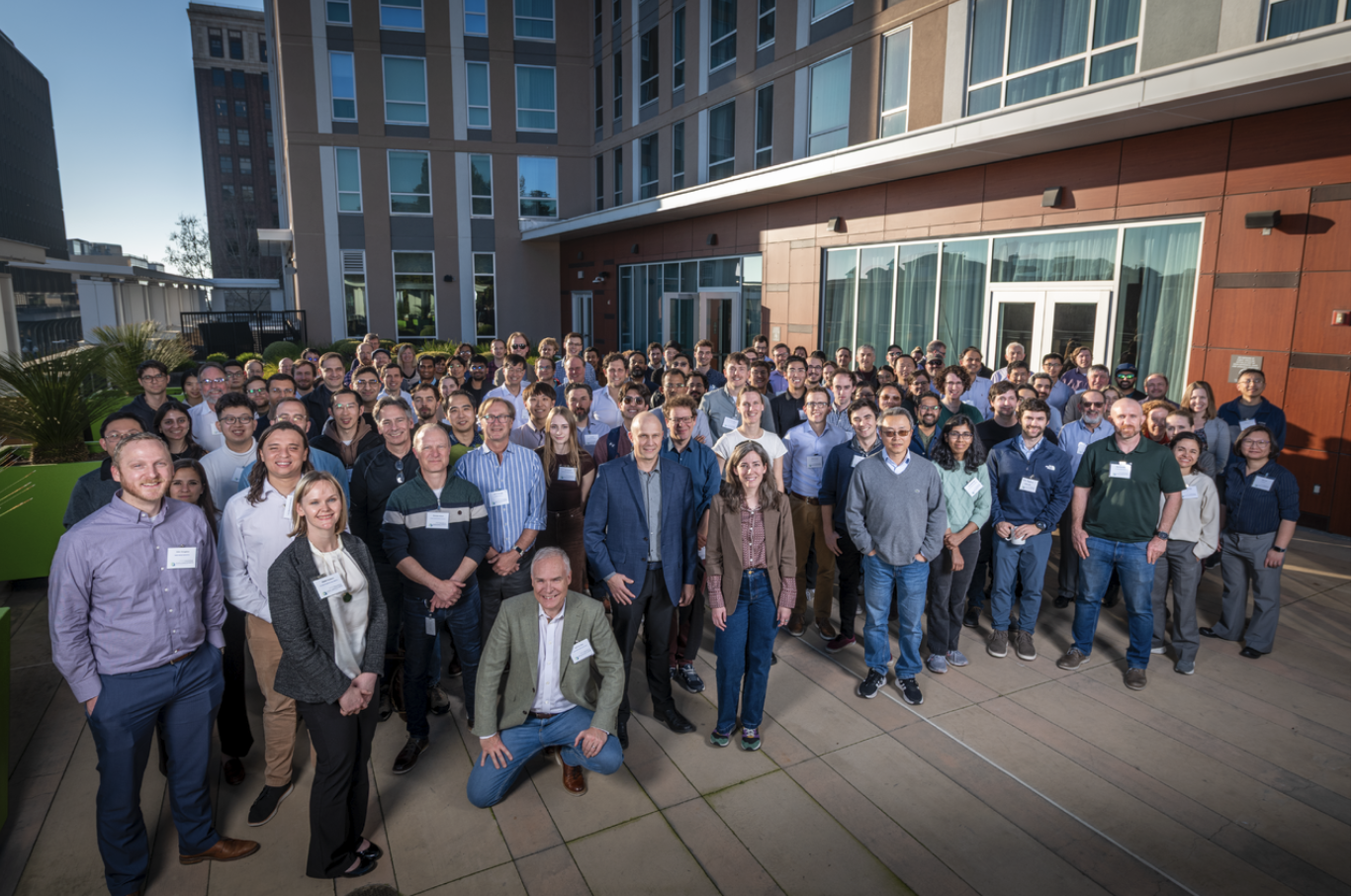
The Quantum Systems Accelerator (QSA) unites national laboratories, universities, and industry partners across North America and internationally to advance the frontiers of quantum information science, technology, and engineering. Since its founding in 2020 as one of the five National Quantum Information Science Research Centers funded by the U.S. Department of Energy Office of Science, QSA researchers across have made significant advances in quantum systems built on neutral-atom, trapped-ion, and superconducting qubit platforms, as well as in new benchmarking applications and software tools that leverage the unique strengths of quantum devices.
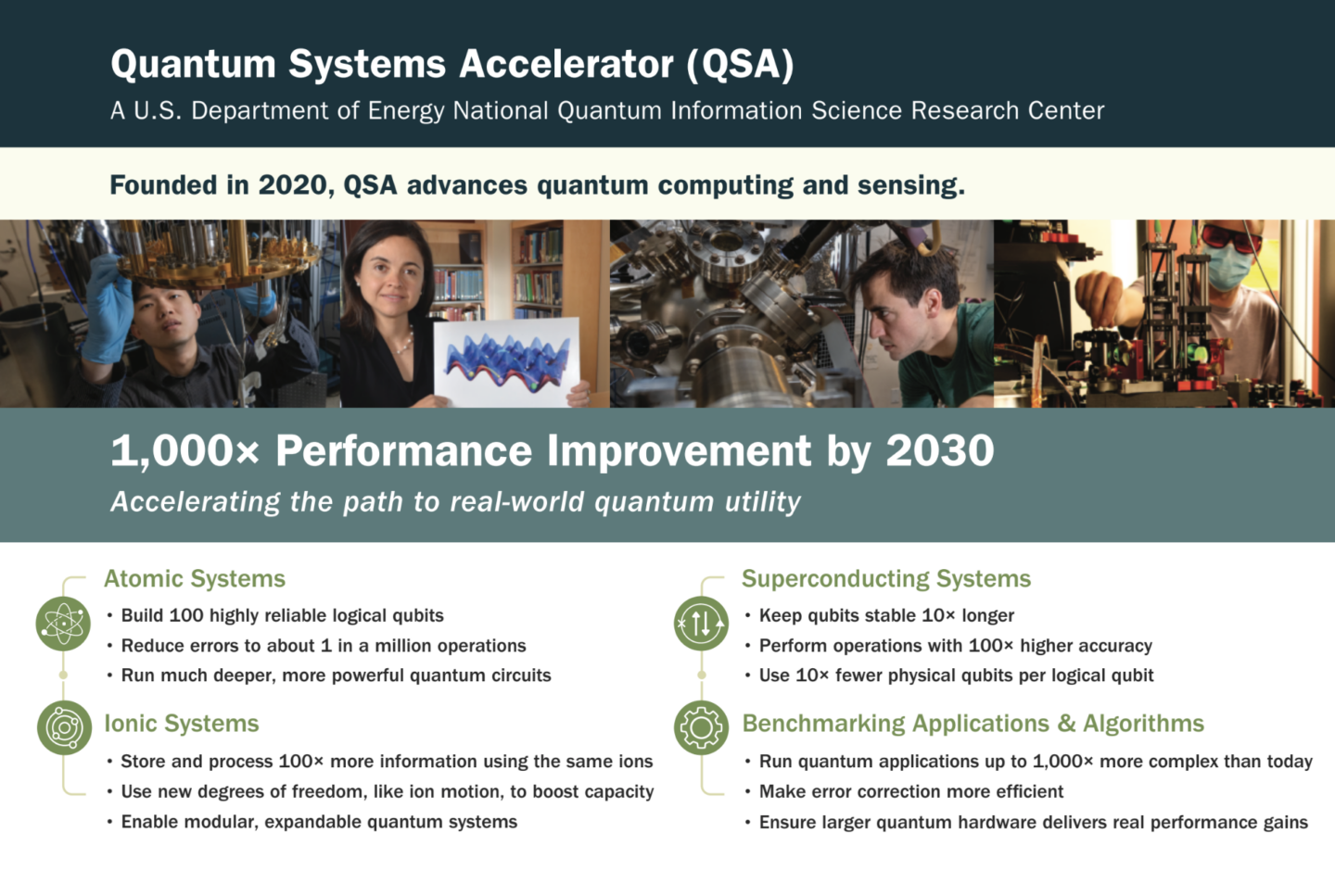
Building on these successes, QSA has a clear and ambitious goal for the near future: to achieve more than a thousand-fold improvement in quantum computing and sensing performance by 2030. This objective will pave the way to “quantum utility,” the pivotal moment when quantum systems can outperform classical computers on meaningful scientific problems and help strengthen the U.S. quantum ecosystem.
To turn this vision into reality, QSA’s mission is driven by two complementary, large-scale efforts. The first focuses on designing and validating programmable quantum simulators, computers, and sensors beyond today’s state of the art. The second is dedicated to building the cross-cutting technologies—including advanced software, modular architectures, and improved error correction—that will make future quantum systems scalable, reliable, and deployable. Continuous industry engagement ensures these scientific results are rapidly translated into commercial tools.
Building tomorrow’s quantum prototypes along interconnected science thrusts
To achieve its goals, QSA’s two large-scale efforts are organized into four interconnected research thrusts that align the efforts of its coalition of 13 universities, three national laboratories, and eight industry partners. This collaborative structure ensures that breakthroughs are shared and leveraged across the entire program. The strategy is built on three parallel efforts to advance core hardware platforms, which are unified by a fourth, cross-cutting thrust dedicated to algorithms and applications.
This coordinated thrust-based structure enables deep progress on specific hardware platforms, including atomic (neutral-atom) quantum systems. Atomic (neutral-atom) systems are naturally scalable and well-suited to both computing and ultra‑precise sensing. Over the next few years, QSA researchers aim to reach 100 logical qubits in atomic systems with extremely low error rates—around one error in a million entangling operations—while enabling much deeper quantum circuits. Logical qubits result from the combination of many fragile physical qubits via quantum error correction, thereby reducing the impact of environmental noise and other disturbances that commonly disrupt quantum operations.
Building on progress across multiple quantum platforms, QSA’s second research thrust advances trapped-ion systems, which are known for operational accuracy and fidelity. Looking ahead, QSA teams are focused on modular ion-based architectures that allow ion chains to be networked and distributed over long distances. In parallel, researchers are developing advanced control and calibration techniques to harness additional degrees of freedom, such as the ions’ motion, and increase information processing capacity by up to a factor of 100.
Superconducting systems form the third core hardware thrust of QSA. QSA researchers will target making quantum systems about 1,000 times better overall, making superconducting qubits stay stable 10× longer, controlling them 100× more accurately at large scale, and designing smarter systems that need 10× fewer physical qubits per logical qubit. To achieve these significant performance gains, researchers will prioritize advances in fabrication materials and packaging, working closely with industry partners that have the manufacturing expertise and infrastructure to scale increasingly large processors operating at cryogenic temperatures.
To ensure that hardware advances translate into scalable performance gains, QSA has a fourth cross-cutting thrust dedicated to benchmarking, applications, and algorithms. Researchers will focus on making quantum error correction as efficient as possible by developing new methods and applications capable of handling problems up to 1,000 times more complex than today’s state of the art, enabling larger, more capable hardware.
QSA’s approach to success is built on delivering steady, measurable milestones that systematically advance quantum systems toward practical capability, and actively driving cross-platform innovation by leveraging solutions from one area to accelerate progress in others. A central element of this strategy is deep integration with industry and high-performance computing partners, ensuring that every new capability is validated in real-world scenarios. This approach bridges the gap between foundational science and a robust quantum ecosystem, building confidence in core technologies, strengthening the vital link between hardware and algorithms, and delivering tangible, repeatable progress.
###
Lawrence Berkeley National Laboratory (Berkeley Lab) is committed to groundbreaking research focused on discovery science and solutions for abundant and reliable energy supplies. The lab’s expertise spans materials, chemistry, physics, biology, earth and environmental science, mathematics, and computing. Researchers from around the world rely on the lab’s world-class scientific facilities for their own pioneering research. Founded in 1931 on the belief that the biggest problems are best addressed by teams, Berkeley Lab and its scientists have been recognized with 17 Nobel Prizes. Berkeley Lab is a multiprogram national laboratory managed by the University of California for the U.S. Department of Energy’s Office of Science.
DOE’s Office of Science is the single largest supporter of basic research in the physical sciences in the United States, and is working to address some of the most pressing challenges of our time. For more information, please visit energy.gov/science.
Sandia National Laboratories is a multimission laboratory operated by National Technology and Engineering Solutions of Sandia LLC, a wholly owned subsidiary of Honeywell International Inc., for the U.S. Department of Energy’s National Nuclear Security Administration. Sandia Labs has major research and development responsibilities in nuclear deterrence, global security, defense, energy technologies and economic competitiveness, with main facilities in Albuquerque, New Mexico, and Livermore, California.
The Quantum Systems Accelerator (QSA) is one of the five National Quantum Information Science Research Centers funded by the U.S. Department of Energy Office of Science. Led by Lawrence Berkeley National Laboratory (Berkeley Lab) and with Sandia National Laboratories as lead partner, QSA catalyzes national leadership in quantum information science to co-design the algorithms, quantum devices, and engineering solutions needed to deliver certified quantum advantage in scientific applications. QSA brings together dozens of scientists who are pioneers of many of today’s unique quantum engineering and fabrication capabilities. QSA’s core team comprises leading research universities, national laboratories, and industry partners worldwide. For more information, please visit https://quantumsystemsaccelerator.org/